Book Chapter: Citizenship, Racism and Settler Colonialism: The Case of Mapuche People, pp. 27-56. In Villalobos, C., Morel, M.J, & Treviño, E. Ciudadanías, Educación y Juventudes. Investigaciones y Debates para el Chile del Futuro. Ediciones UC
2021
Álvaro Hofflinger & Hector Nahuelpán

Abstract
En una sociedad que asume los principios de la democracia, se espera que el rol principal del estado sea promover y reproducir ciertos valores compartidos entre sus ciudadanos, para lo cual la educación sería una de las herramientas claves para reforzar los valores y las tradiciones colectivas (Dewey, 1916). Sin embargo, en contextos históricos y territoriales donde el estado y la educación formal surgieron y se han construido a partir de la negación de la soberanía de los pueblos indígenas, despojando y colonizando sus territorios, la promoción y ejercicio de principios como la democracia, la ciudadanía o la formación ciudadana, se encuentran fuertemente tensionados. Con el propósito de indagar en esta controversia, este capítulo se enfoca en las tensiones entre formación ciudadana, racismo y colonialismo de asentamiento en el contexto mapuche. Si bien esta problemática tiene diversas aristas y complejidades, nuestra aproximación se acota en explorar la siguiente pregunta: ¿cuál es el efecto de la discriminación en el nivel de participación y formación ciudadana de los estudiantes indígenas en Chile? Nuestro argumento principal es que, en el contexto mapuche, la construcción de la ciudadanía ha operado en el marco de una relación y estructura de colonialismo de asentamiento. Esta estructura ha girado históricamente en torno al despojo-posesión de la tierra y el objetivo (no cumplido) de reemplazar a la población mapuche por una sociedad de colonos (no indígenas), generando una formación social altamente segregada en términos de líneas étnico-raciales. Los resultados de este capítulo, proponemos, son el reflejo de este proceso sociohistórico en curso.
Another One Breathes the Dust. The Relation Between Severe Air Pollution Episodes and School Attendance in Southern Chile.
2021
Álvaro Hofflinger & Alex Boso

Abstract
The intermediate-sized cities of southern Chile experience days of high pollution levels every winter due to the use of wood-burning stoves. Several studies have analysed the factors that hinder energy transition and the social acceptance of measures to improve air quality, the consequences of which are disturbing. However, they have mainly focused on health issues without considering the social impacts of air pollution. This study aims to assess whether exposure to outdoor air pollution is associated with school absenteeism. We analysed the records of approx. 5,000 students in the fourth grade from 25 schools in five cities in southern Chile (2010–2017). Using a fixed-effects model and applying it to the school level, we were able to estimate the effect of air pollution on absenteeism from school after controlling for the effects of individual characteristics. Previous studies have found that independent of air pollution, students from low-income families have a higher absenteeism rate. Our findings suggest that as air pollution worsens, pupils from middle and high-income households are also more likely to miss school days. We argue that this is, presumably, because high-income families are able to develop protective behaviour such as bringing their children to the doctor or keeping them at home on highly polluted days.
Missing Children: How Chilean Schools Evaded Accountably by Having Low-Performing Students Miss High-Stakes Test.
2020
Álvaro Hofflinger & Paul T. von Hippel
Abstract
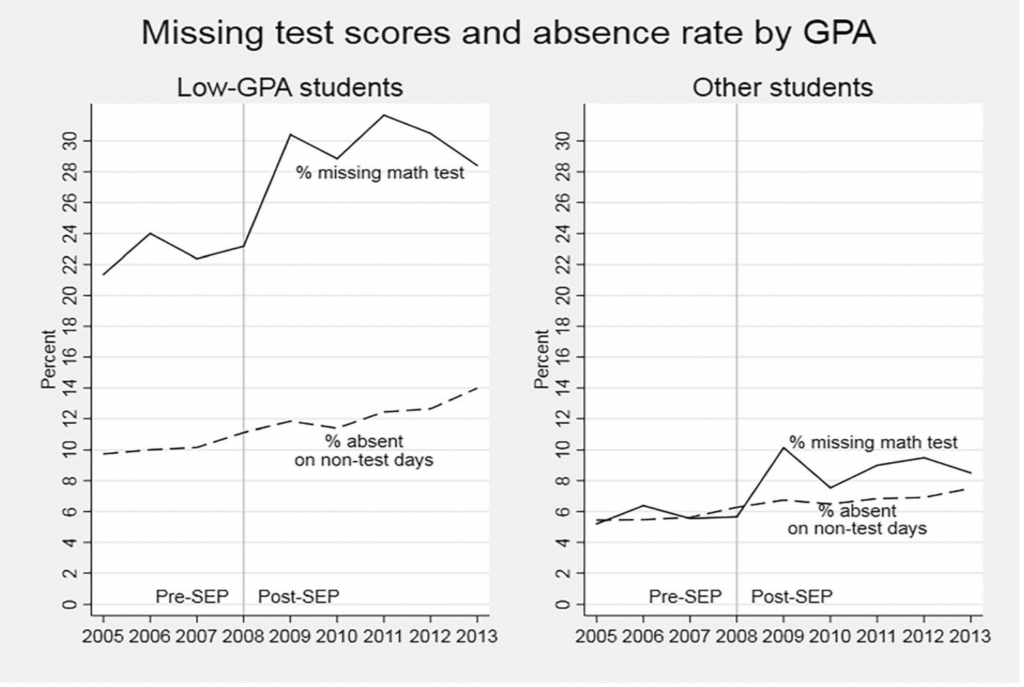
High-stakes testing pressures schools to raise test scores, but schools respond to pressure in different ways. Some responses produce real, broad increases in learning, but other responses can raise reported test scores without increasing learning. We estimate the effect of an accountability program on reading scores and math scores in Chile. Over a 6-year period, fourth-grade reading and math scores rose by 0.2 to 0.3 standard deviations, on average, and half the rise was due to the accountability program. However, many schools, especially schools serving disadvantaged students, inflated their accountability ratings by having low-performing students miss high-stakes tests. To encourage healthier responses to accountability, we recommend setting accountability goals that are attainable for schools with disadvantaged students, and providing incentives for all students to take high-stakes tests.
Does Achievement Rise Fastest with School Choice,School Resources, or Family Resources? Chile from 2002 to 2013.
2020
Álvaro Hofflinger & Paul T. von Hippel
Abstract
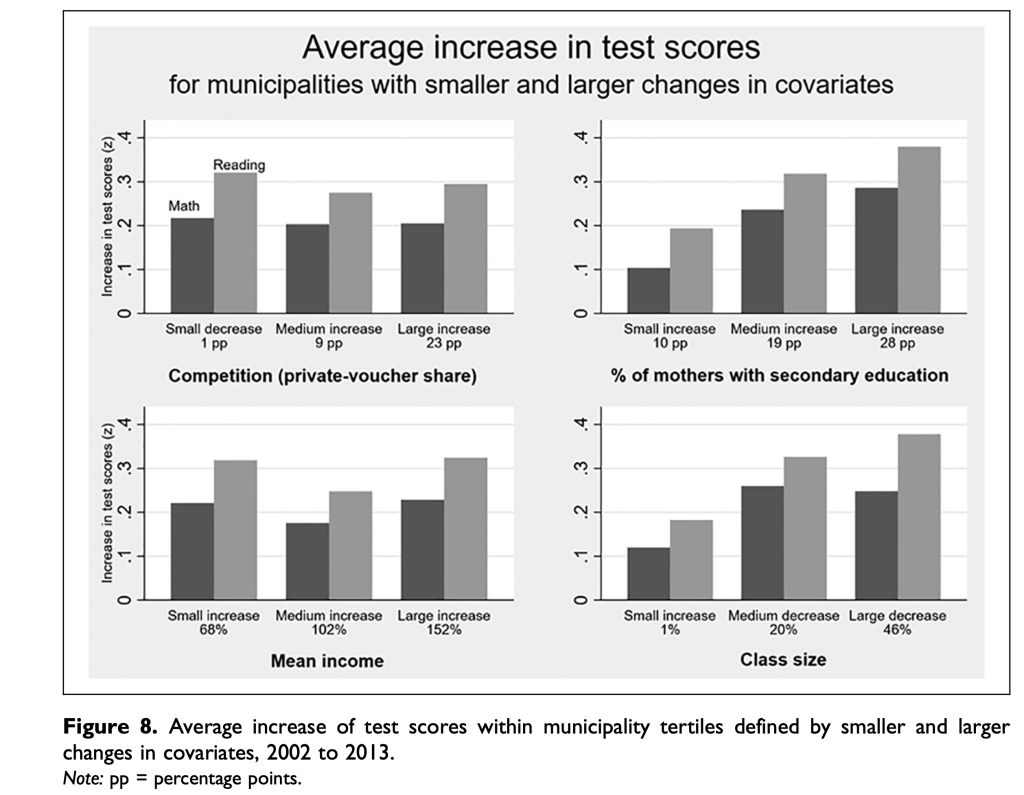
Debates in education policy draw on different theories about how to raise children’s achievement. The school competition theory holds that achievement rises when students can choose among competing schools. The school resources theory holds that achievement rises with schools’ resources per student. The family resources theory holds that achievement rises as parents become more educated and earn higher incomes. We test all three theories in Chile between 2002 and 2013, when reading and math scores rose by 0.2 to 0.3 standard deviations, as school competition, school resources, and family resources all increased. We compare Chilean municipalities in a difference-in-differences analysis, asking whether test scores rose fastest in municipalities with greater increases in school competition, school resources, or family resources. We find that municipal test scores did not rise with school competition but did rise with family resources (parental education, not income) and, to a smaller extent, with school resources (as measured by class sizes). Results favor the family resource theory, and to a lesser extent the school resource theory, but not the school competition theory.
The Data Revolution Comes to Higher Education: Identifying Students at Risk of Dropout in Chile.
2020
Paul T. von Hippel & Álvaro Hofflinger
Abstract
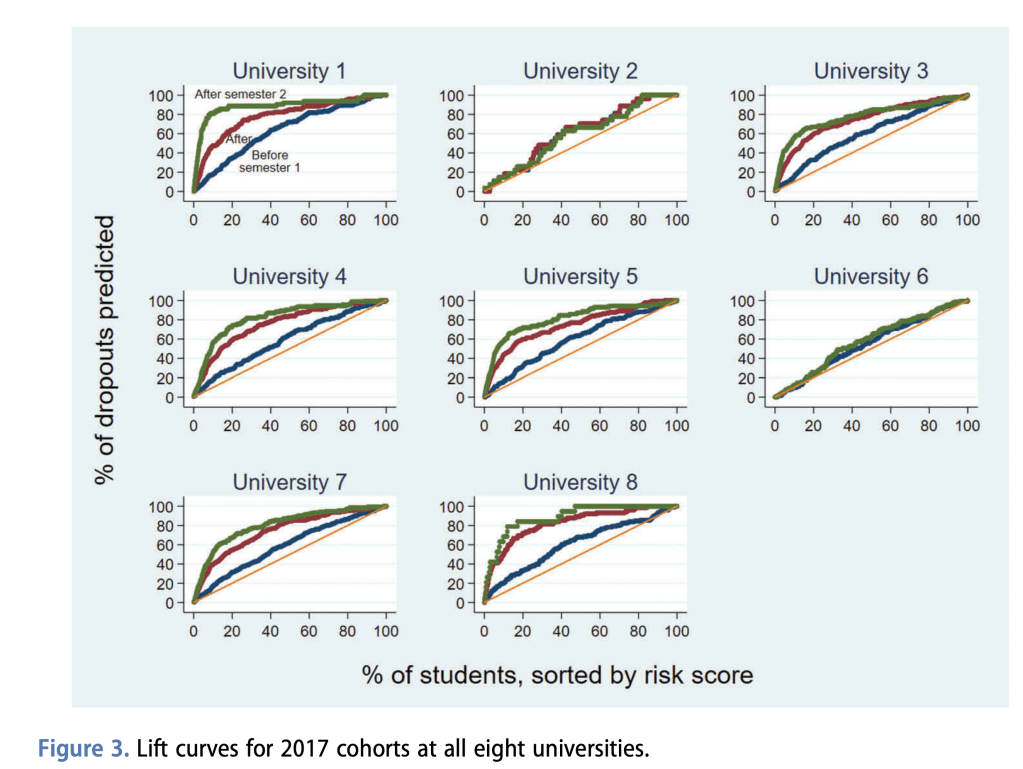
Enrolment in higher education has risen dramatically in Latin America, especially in Chile. Yet graduation and persistence rates remain low. One way to improve graduation and persistence is to use data and analytics to identify students at risk of dropout, target interventions, and evaluate interventions’ effectiveness at improving student success. We illustrate the potential of this approach using data from eight Chilean universities. Results show that data available at matriculation are only weakly predictive of persistence, while prediction improves dramatically once data on university grades become available. Some predictors of persistence are under policy control. Financial aid predicts higher persistence, and being denied a first-choice major predicts lower persistence. Student success programmes are ineffective at some universities; they are more effective at others, but when effective they often fail to target the highest risk students. Universities should use data regularly and systematically to identify high-risk students, target them with interventions, and evaluate those interventions’ effectiveness.
School Choice and Parents’ Preferences for School Attributes in Chile.
2020
Álvaro Hofflinger, Denisse Gelber, Santiago Tellez Cañas

Abstract
A key assumption of school choice and competition policies is that parents’ most important (if not only) priority when choosing a school is its quality. However, evidence about which of a school’s attributes really drives parental choice is still scarce. We use census data from a parent questionnaire in Chile, a country with a national school choice and competition system, to describe the attributes most commonly considered by parents when choosing a school, and to assess how the probability of prioritizing those attributes varies with the parents’ socioeconomic characteristics, while controlling for other characteristics of the family. We find that parents choosing a school prioritize its proximity, its quality, and whether it provides religious education. Furthermore, the probability of parents prioritizing proximity is higher for parents of low socioeconomic status, while the probability of them prioritizing quality and religious education is higher for parents of high socioeconomic status. These findings show that only advantaged families choose schools based on their quality, and therefore school choice and competition policies may offer a limited benefit for disadvantaged pupils, possibly maintaining or reinforcing socioeconomic segregation in the education system.
Scientific Output In Chile: Limitations of The Use of Performance Indicators to Evaluate Public Universities
2018
Álvaro Hofflinger & Arturo Vallejos-Romero
Abstract
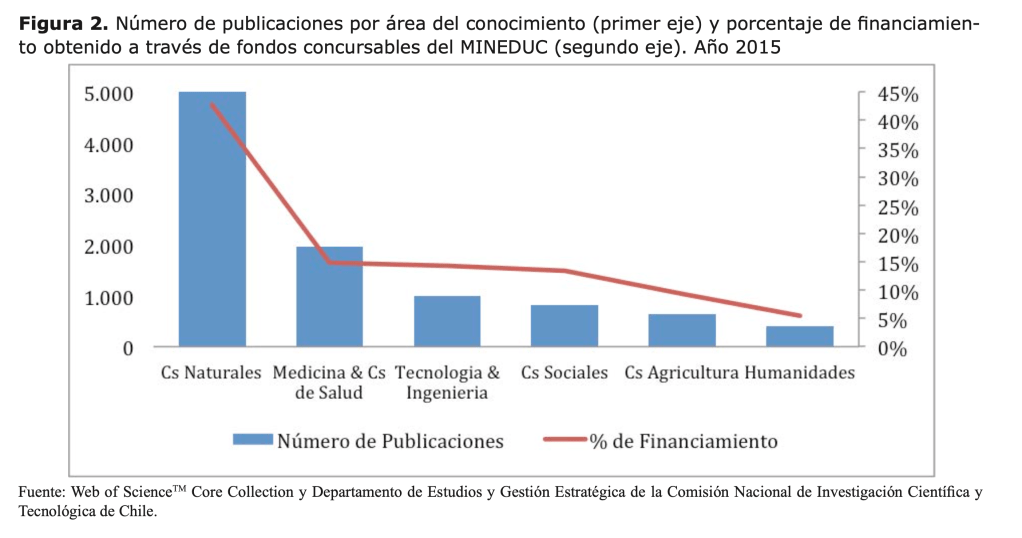
In 2015, the 25 universities that are members of the association of public universities (CRUCH) received $15.3 million as a reward for performance. The money that each university received depended on its position in the ranking of performance indicators. The performance indicator with the highest weight is the index of productivity (35%), which represents the ratio between the number of indexed publications divided by the number of academics at each university. This index does not distinguish publications by areas of knowledge, by quality or by intellectual author. Because of this, the index has been criticized as an unfair way to rank universities. To study this, we analyze10.377 papers indexed in the Web of Science by CRUCH universities in 2015. Our objective is to study the unintended consequences of the use of indexed publications as an indicator of productivity and estimate its impact on finance equity among universities and topics.
 Alvaro Hofflinger